By: M. Prayoga Aidil Fitri, Pundi Sumatera
Negan is part of the Rombong Juray Pematang Kejumat Suku Anak Dalam (SAD) community, residing in Limbur Tembesi Village, Sarolangun Regency. Like many members of his community, he lives in a context of rapid social and ecological change. Forests, once the primary living space, have been shrinking, replaced by oil palm plantations. These changes in the landscape have impacted not only the environment but also the livelihood systems, social relations, and the bargaining power of indigenous communities in public spaces.
In recent years, some members of the SAD community have adapted to working as oil palm fruit collectors, scrap collectors, or other informal laborers. These jobs are unstable and often place them in a legally and socially vulnerable position. They are often suspected of harvesting oil palm without permission or considered a disturbance. The stigma of being called "suku kubu" (a tribe of smallholders) remains a common theme in everyday conversation among local residents.
Negan grew up and lived in this situation. He also has a physical disability. In a social context already rife with stigma against indigenous identities, his disability adds another layer of vulnerability. The obstacles he faces are not only technical issues related to his physical condition, but also others' perceptions of his abilities. Moreover, in many informal workplaces, ability is often measured by certain physical standards. For Negan, the space to prove himself is not always available.
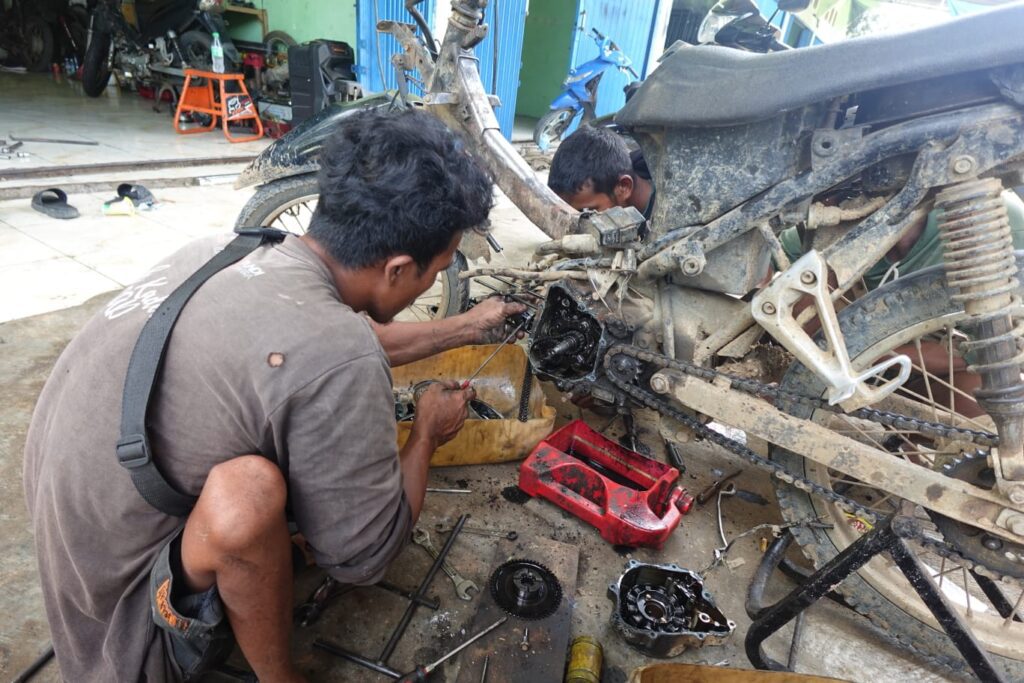
Nevertheless, Negan has a persistent interest in motorcycle engines. His work as a palm oil harvester makes motorcycles his primary work tool. The rough terrain and long distances he travels often cause his bike to break down: broken chains, worn gears, flat tires, or electrical problems. Repair costs are a burden. This situation sparked his curiosity about whether he could fix them himself.
Ari's motorcycle repair shop, located not far from his home, became the initial learning space. The owner had long-standing relationships with the SAD community, so the interaction proceeded smoothly. One day, when the service line was quite long, Negan asked permission to try repairing his motorcycle himself with the available tools.
At first, he observed. He watched mechanics unscrew stuck bolts, change gears, or adjust chains. When he encountered difficulties, he asked questions. The interaction was on an equal footing. There was no condescension when he didn't know something. Through the process of trial and error, he began to understand the logic of how machines work. His successful self-repair of gears became a significant milestone. This experience built his confidence in his abilities.
The workshop owner then offered him the opportunity to help with light work. Negan wasn't positioned as an object of pity, but rather as an individual learning. Interactions with customers also began to change. They saw firsthand the results of Negan's work. At this stage, the changes were still personal. Self-confidence increased, skills developed, and social relationships began to shift. However, structural change had not yet occurred. The stigma against the SAD community in general remained strong in the public sphere.
Mentoring from Pundi Sumatra then saw this potential as a gateway to more systematic empowerment. Rather than offering training from the outset, facilitators first observed the interests and practices that had already emerged organically.
Negan and several community members were facilitated to participate in motorcycle technical training at SMK Negeri 10 Merangin. This training consisted of two stages: light service and heavy service. Access to formal education for indigenous communities is not common. In many cases, limited documentation, social distance, and lack of confidence present barriers. However, established communication between the facilitator and the school opened the way.
During the training, Negan demonstrated his ability to thoroughly understand how machines work. The interns observed that he wasn't just copying, but rather understanding how they work. After the training, the next challenge was accessing internships at general repair shops. The facilitators attempted to visit three repair shops in the Limbur Tembesi area. All three declined. The reason given remained the same: fear that customers would switch if they learned there were SAD members interning there.
However, this situation didn't stop the learning process. Negan proposed an alternative idea. He knew a repair shop owner at Pamenang Market, Mr. Widodo, from having his motorcycle repaired there. In previous interactions, he had expressed an interest in tinkering with engines. Together with the facilitator, he applied for an internship.
Mr. Widodo accepted, believing that everyone has an equal opportunity to learn. During the three-day internship, Negan and his colleagues worked alongside other mechanics, repairing customer vehicles, and learned more systematic work methods. They also encountered situations where equipment was incomplete and needed to find alternative solutions. The adaptability they had developed in the context of living in the jungle was a plus.
Interestingly, there was no decrease in customers during this process. In fact, at Ari's previous workshop, the number of customers actually increased when people saw that Negan was able to repair motorcycles with satisfactory results. This demonstrates that public perception can change through direct interaction.
Even though the workshop business has not become Negan's main source of income (because he still farms oil palm and raises cattle as a source of livelihood), the changes that have occurred are not solely measured by the increase in income.
Negan is slowly given the space to demonstrate his potential without being limited by his physical condition. He's treated neither as a burden nor as a symbol of inspiration, but as an individual with skills that can be developed.
Acceptance in formal workshops and educational institutions also demonstrates the opening of previously closed access. Initial resistance demonstrates that barriers are structural, not personal. When a workshop opens up, perceptions shift within the broader community.
Negan realized that this process wasn't over. He expressed his desire to one day open his own workshop in his neighborhood. Mr. Widodo also expressed his willingness to provide technical assistance if needed. This kind of support expanded his social network beyond the indigenous community.
This story demonstrates that change doesn't always begin with major interventions. It can begin with curiosity about a worn gear, or the courage to ask about a stubborn bolt. But for change to be sustainable and have a structural impact, support that is sensitive to the social context, including identity- and disability-based discrimination, is needed.
The mentoring provided did not replace Negan's role as the primary subject. Instead, it empowered him because he already had interest and initiative. Now, the visible changes extend beyond technical skills. They include increased self-confidence, reduced teasing, and increased dialogue between the SAD community and the surrounding community. Identity as an indigenous person and a person with a disability is no longer a barrier, but rather part of a journey that fosters resilience and adaptability.
Negan exemplifies how social inclusion, access to training, and cross-community partnerships can strengthen individual dignity while reducing structural discrimination. This story is not simply about individual success, but about how social systems can change when opportunities are equitably provided. Negan is no longer simply recognized as part of a marginalized group. He is recognized as a competent mechanic, as an individual with choices, and as an equal citizen in his social space.