By: Bambang Sagurung, YCMM
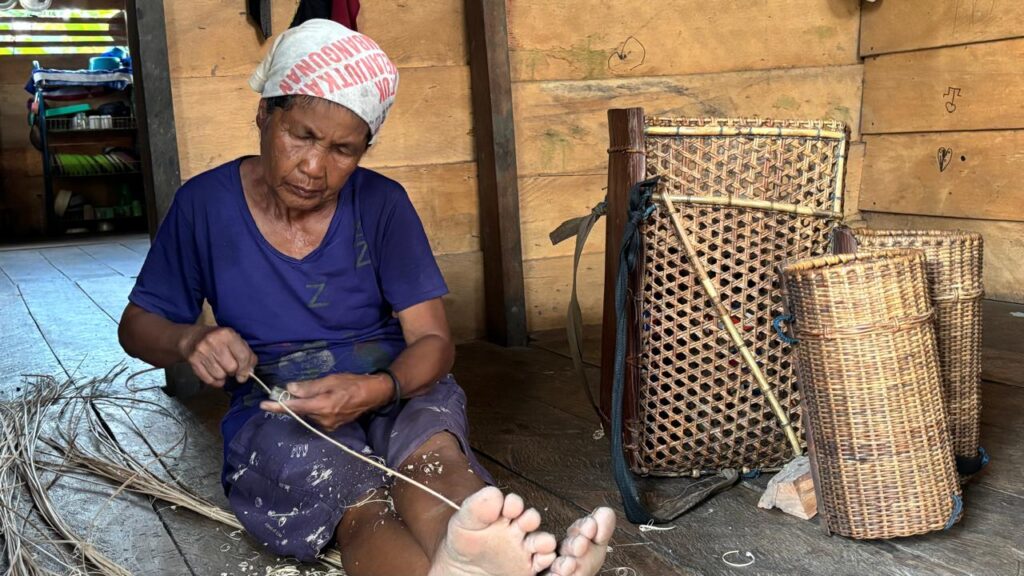
The sun was not yet high when Neubuk (69) sat down on the veranda of her son's wooden house in Ukra Hamlet, Malancan Village, North Siberut District, Mentawai Islands. In her hand was a traditional knife—a tool that had accompanied her for decades and was now one of her late husband's most treasured heirlooms.
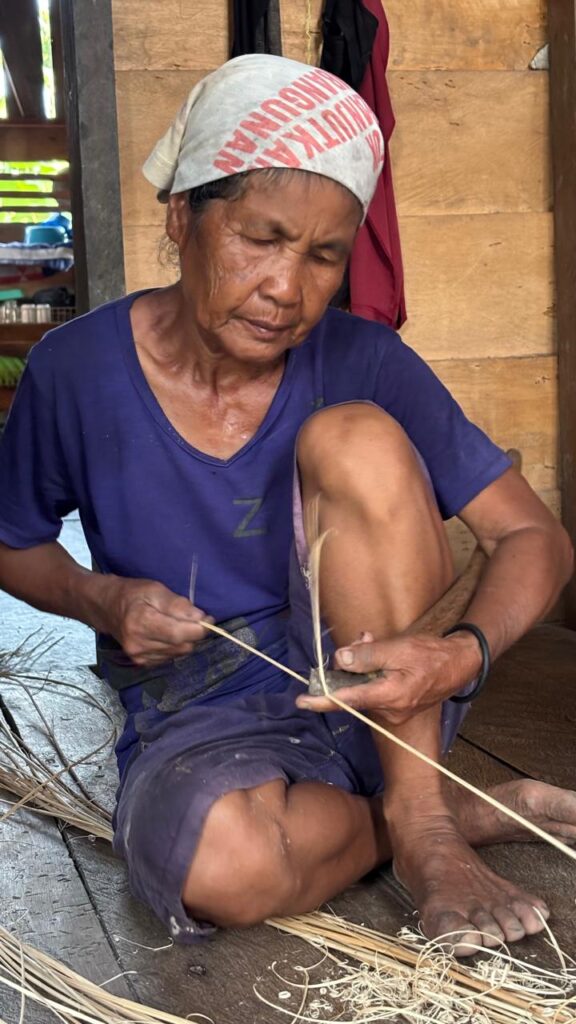
In front of him, several rattan blades that had been split and dried in the sun were neatly arranged. With slow but steady movements, he began to sharpen the surface of the rattan, cleaning the rough fibers until it became a thin sheet ready to be woven.
There were no hurried movements. Each pull of the knife revealed a habit he had practiced over and over again throughout his life.
“Amareuan,” he said briefly with a smile.
It's been a long time.
That Sunday evening in mid-July, Neubuk was trying to finish two oorek, a traditional Mentawai backpack basket usually used to carry garden produce or daily necessities.
"If these two are completed, I will get Rp. 220 thousand," he said.
That amount may sound small. But for Neubuk, the money isn't just the proceeds from selling crafts. It's savings for when she's sick, for medication not covered by BPJS, and for when food supplies at home start to run low.
At nearly seventy years old, Neubuk no longer weaves solely to meet household needs. Weaving has now become a means of survival.
For the Mentawai people, weaving is not a skill learned through short training sessions. It is knowledge passed down across generations, embedded in the daily lives of the indigenous people.
Both men and women mastered weaving techniques, but for different purposes. Women generally made household items such as storage containers and kitchen utensils. Meanwhile, men made equipment for hunting, farming, and forestry activities.
This knowledge doesn't stop at weaving techniques. The Mentawai people also possess ecological knowledge passed down through generations regarding how to select rattan without damaging the sustainability of the forest. The rattan selected isn't just any rattan.
Only truly mature rattan is harvested. This is recognized by the length of the stems, which have grown to tens of meters, a harder texture due to reduced moisture content, and a color that indicates the maturity of the fibers. Mature rattan produces stronger, more flexible, and more durable weaving.
Instead, young rattan is allowed to grow. Allowing it to survive ensures a supply of raw materials for future generations. This knowledge is part of the Mentawai people's way of maintaining a balance between their livelihoods and forest conservation.
Neubuk never imagined that gathering rattan would be the most tiring task in the weaving process. When he lived in Gorottai Village, rattan grew in abundance.
He only had to walk about 100 to 200 meters from home. Within one to two hours, he could bring home enough rattan to work with. The situation was different now.
Since moving to Ukra Hamlet about a year ago, Neubuk has had to spend entire days going in and out of the forest just to find a few rattan stalks. He has to walk for kilometers, often returning with little to show for it.
“This Leleu is not my fault,” he said.
“I don't understand the forest here yet.”
The difficulty wasn't just due to his unfamiliarity with the forested area in his new home. The landscape of Ukra Hamlet had also changed. Increasingly extensive land clearing had reduced the area where rattan used to grow. Furthermore, the presence of rattan collectors exacerbated the situation. According to residents, rattan was harvested without regard for plant age—both old and young rattan were harvested simultaneously.
As a result, the supply of rattan for regrowth is dwindling. In fact, according to Mentawai indigenous knowledge, harvesting young rattan means eliminating future raw material supplies. This change is slowly making weaving skills no longer sufficient to rely solely on manual skills.
Now, the biggest challenge begins with finding the materials. Three days for one weave. Before becoming a basket, the rattan must go through a lengthy process. The rattan stems are cut, then split into pieces about three to five centimeters in size. After that, they are dried in the sun until the moisture content reduces. Only then does Neubuk begin to whittle them down. The whittle time cannot be arbitrary.
He chooses morning or evening because that's when the rattan is softer and less likely to break. During the day, the rattan becomes harder and more susceptible to damage when sharpened.
Once all the rattan slats are ready, the weaving process begins. This entire process takes about three days to complete one product. Neubuk typically only receives one or two orders a month. He also doesn't make many products. oorek And long chicken, a woven container for carrying chickens.
Oorek large size is sold for around Rp. 120 thousand, small size Rp. 110 thousand, while long chicken It sells for between Rp 35,000 and Rp 50,000. Since participating in the Estungkara Program mentoring program of the Citra Mandiri Mentawai Foundation (YCMM) in early 2026, Neubuk has resumed producing woven products for sale.
Initially, she had doubts. She wasn't sure if anyone would still be interested in buying her weavings. Through discussions with her mentor and encouragement from her son, Japet, she finally worked up the courage to try again.
The first orders came from local residents. Then, word of mouth spread about Neubuk's weaving. For buyers outside the village, YCMM helped promote the weaving and deliver incoming orders.
From this activity, Neubuk earns an additional income of around Rp 120,000 to Rp 575,000 per month. This amount isn't a large amount. However, for an elderly woman who no longer has a steady income, the additional income provides the space to make decisions about her own needs.
However, weaving wasn't Neubuk's only occupation. At her son's house, she continued to perform various domestic tasks. When Japet (Neubuk's son) and her husband went to the fields in Gorottai Village—a journey that required them to stay overnight for two days or even a week—Neubuk looked after her grandchildren at home.
She cooks, cleans, takes care of daily needs, and occasionally helps her grandchildren after school or on holidays. Neubuk also continues to garden. Because her family doesn't have their own land in Ukra Hamlet, they rent someone else's land to grow sweet potatoes and various vegetables to feed the family.
All the work goes on simultaneously. Taking care of the house, looking after grandchildren, gardening, looking for rattan, whittling and weaving. Everything was done at a young age. For many indigenous women, productive work and care work have never been truly separate. Both take place at the same time and mutually support family life.
Neubuk's move from Gorottai Village was not an easy decision. The village was gradually abandoned by its residents. The lack of road access to the village center made it increasingly difficult for the community to access education, basic services, and economic opportunities.
One by one, families decided to move to other hamlets, including Sirilanggai, Ukra, and Malancan, which are about five to fifteen kilometers away. Neubuk later joined her children in Ukra Hamlet after her husband died.
“We actually had a nice house, clean water, and fertile land there,” he recalls.
But housing alone is not enough when access to a more decent life is increasingly limited.
For Japet, the move meant starting everything from scratch.
“We have to rebuild our house, plant on borrowed land, and do whatever work we can,” he said.
In such situations, income from Neubuk weaving becomes a means of supporting the family's needs. For Neubuk, weaving is never just about making things. It is a connection between people and the forest. Without the forest, there is no rattan. Without rattan, the knowledge of weaving is slowly disappearing. Without that knowledge, one of the indigenous people's means of survival is also threatened. Therefore, when asked what is most important for the future, the answer is very simple.
"You know how good you are, Leleu. Leleu nen ibara purimanuaijan."
"We have to protect our forests. It is the forests that give us life."
This sentence isn't just a call to protect the environment. For Neubuk, protecting the forest means protecting food sources, preserving ancestral knowledge, preserving women's work, and ensuring the possibility for future generations to live off nature without depleting it.
In Neubuk's hands, each rattan blade is not only transformed into a woven product, but also serves as a reminder that the survival of indigenous communities always begins with a well-preserved forest.