By: Muslimin Lancong, SCF
Economic change within the indigenous community is thriving in Kaluppini Village, a jewel of traditional values in Enrekang Regency, South Sulawesi. A series of social entrepreneurship discussions was initiated by the Sulawesi Cipta Forum (SCF), the implementer of the Partnership's Estungkara Program. The focus of this activity is on women and youth in Kaluppini Village. The rationale is simple yet powerful: women are known to be more dominant in socializing and initiating conversations within the community. The hope is that daily conversations within the community will shift to the potential and success of chili cultivation.
Last May, two discussion activities were held with Mr. Beni Arman from the Center for Education, Training and Self-Help Rural Areas (P4S) Laskar Pelangi Salo Dua Maiwa, as the main resource person. Mr. Beni Arman (45), an accomplished practitioner in the fields of agriculture, plantations, animal husbandry, and fisheries, as well as the owner of the Plant Variety Protection (PVT) for Salo Dua Chili, a superior local chili variety from Enrekang, successfully transmitted his enthusiasm and valuable knowledge.
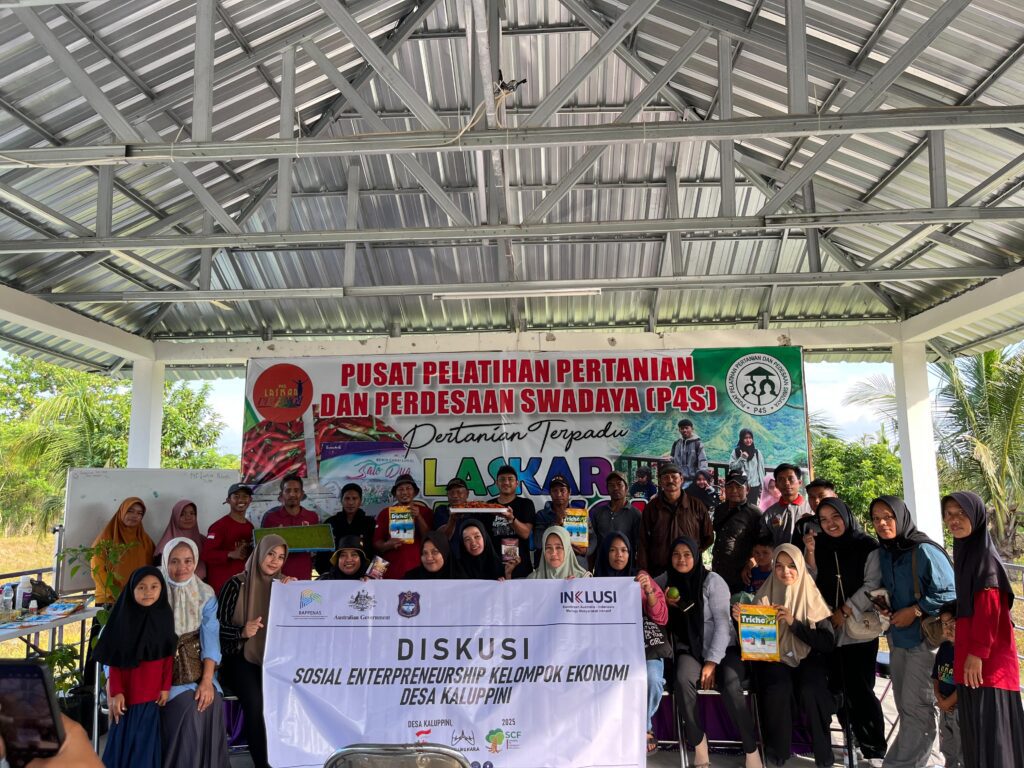
The first discussion was held in Kaluppini Village, with the majority of participants being women. This session opened their minds to the potential of social entrepreneurship and how they can play an active role in improving family well-being. The mothers' enthusiasm demonstrated their awareness of the importance of economic independence.
The second activity continued at the Laskar Pelangi Salo Dua P4S production site in Maiwa District, with an in-depth focus on chili cultivation. Participants not only received theoretical material but were also invited to participate in direct observation. They witnessed and practiced the process of sowing seeds, preparing the planting medium, caring for chilies, and post-harvesting. This hands-on experience is crucial for building confidence and skills.
Mr. Sulaiman (50), one of the participants, said, “This activity is a new experience and I gained new knowledge that I will apply when I return to Kaluppini Village.” Mrs. Ramlah (32) also added, “My experience farming chilies is very profitable, for example when school children need pocket money, it is immediately available. So, in essence, if you want to keep the smoke from your kitchen rising, then chili cultivation is the solution, especially if there are collectors in the village, then farmers will no longer have difficulty finding a market.” Mrs. Ramlah’s statement further strengthens the reason why women are the main target, because they directly feel the real economic impact of chili cultivation.
Following these two discussions, interest in chili cultivation among the Kaluppini Village community, particularly among women and youth, has skyrocketed. To date, 60 farmers have sown Salo Dua chili seeds. The Laskar Pelangi P4S will continue to assist them as consultants, with Mr. Beni Arman ready to share his knowledge and experience if farmers encounter any challenges.
Integrated and Sustainable Economic Ecosystem
SCF, in collaboration with KEMITRAAN, through the Estungkara Program, is also designing a comprehensive economic ecosystem for Kaluppini Village, involving all existing economic groups. The Merah Putih Cooperative (KMP) will be the leader in driving the village economy. KMP not only serves as a source of capital but also as a collector and market access provider for all village products, including agricultural, plantation, livestock, and other products.
Meanwhile, Village-Owned Enterprises (BUMDes) will focus on production activities and farmer mentoring. This concept aims to allow farmers to fully concentrate on production without worrying about marketing their crops. BUMDes will act as consultants and advisors when farmers encounter obstacles in the production process.
Interestingly, the Salo Dua chili cultivation will adopt an organic farming concept, utilizing goat manure as the primary fertilizer. This aligns with the Village-Owned Enterprise (BUMDes)'s plan to develop goat farming through a food security program funded by Village Funds. The hope is to create an integrated agricultural and livestock farming system.
To support the sustainability of this activity, the Kaluppini Village community will initiate a Horticultural Field School with Chili Cultivation material. Mrs. Fatmawati, one of the Kaluppini indigenous women, has even prepared land next to her house as a demonstration plot (demplot) for chili cultivation. Mr. Muhammad Ikbar (48), PLH. Food Crops, Horticulture and Plantation Service (DTPHP) Enrekang Regency, welcomed this initiative and directed them to coordinate with the Coordinator of Agricultural Extension Workers (PPL) Enrekang District to request facilitation from the Regency Extension Division in the Horticultural Field School activities.
With an approach that empowers village women and youth as agents of change, and support from various parties such as the Laskar Pelangi (Rainbow Troops) Community Development Center (P4S), the Food Crops, Horticulture, and Plantation Service, the Village-Owned Enterprises (KMP), and the Village-Owned Enterprise (BUMDes), Kaluppini Village is on the right track toward economic independence and sustainable prosperity. This transformation is not just about growing chilies, but also about cultivating hope and a brighter future for the entire community.