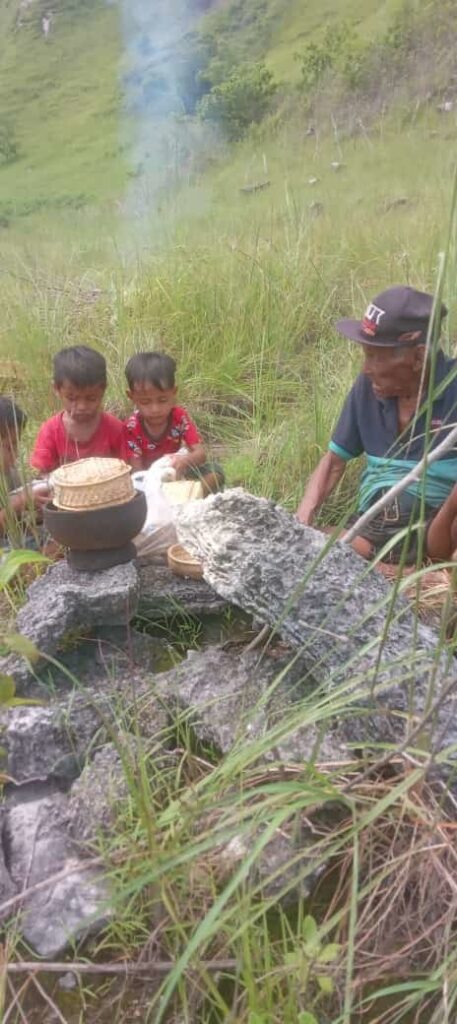
In Kalamba village there is a traditional ritual called Hamyang. An ancient tradition that is believed to bring blessings and spiritual connections to nature. This ritual is held before the big harvest in the garden. As a form of expression of gratitude to God Almighty for the blessings given. Namely, in the form of abundant garden produce.
Since the first ancestors, rituals Hamyang has become an inseparable part of the lives of indigenous people in this village. Held once every year before the harvest, this ritual is considered important to ensure the abundance of garden produce and the welfare of indigenous communities.
Before carrying out the ritual, preparations must be carried out carefully. Preparations include selecting 1 female chicken and 2 male chickens. As well as providing betel nut as a symbol of togetherness and the purity of this ritual. Traditional figures will act as spokespersons who lead and explain the intent and purpose of each ritual step.
The main purpose of the ritual Hamyang is to convey gratitude to God for the garden produce given. Even though the garden's harvest has been confirmed, this ritual is still carried out as a form of respect and awareness of the connection between humans and nature. Failure to carry out this ritual can have a negative impact on future garden yields. Because it is believed that the success of the harvest is related to the spiritual balance that is maintained through this ritual.
Rituals Hamyang is an important part of the cultural and spiritual heritage of the indigenous people in Kalamba village. Even though not all clans or groups carry out rituals, this activity is still maintained and preserved every year by those who understand the value and meaning contained in it. Through support from the Bumi Lestari Institute, efforts are made to motivate indigenous communities to maintain traditions such as Hamyang keep doing it.
This aims to maintain the continuity of this tradition for the sake of future generations. On the day of the ritual, the atmosphere around the kathode watu, the stone statue where the ritual is carried out, is full of solemnity and reverence. Three children were tasked with holding the chicken while the traditional figure as speaker led the ritual. The chicken that has been offered is then slaughtered and eaten together as a symbol of unity and sharing between humans and nature.
In all, ritual Hamyang is not just an event, but an expression and belief and a deep relationship between humans and nature and the creator. By maintaining and strengthening traditions like these, the indigenous people of Kalamba village not only maintain their cultural heritage, but also the spiritual balance and connection to nature that have been an integral part of their lives for centuries.
*This article was written by: Erick, Bumi Lestari Institute