By: Sulawesi Cipta Forum (SCF)
"If traditional schools existed, what would they look like?"
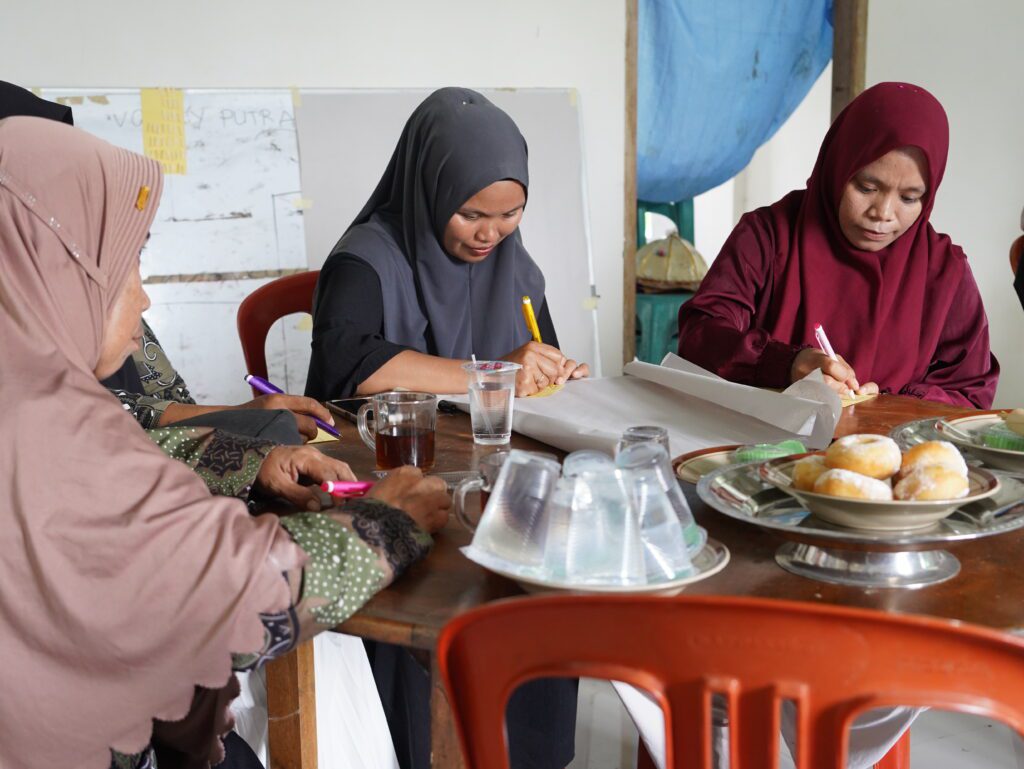
The questions asked by Ma'ruf, the FGD facilitator, were then answered by participants in a simple way: by drawing.
On flipcharts, village officials, women, and youth outlined their visions of the traditional school they desire. The FGD was facilitated by the Sulawesi Cipta Forum (SCF), the Kaluppini Village Government, and the Sappulo Tallu collective, a group focused on cultural issues in Kaluppini.
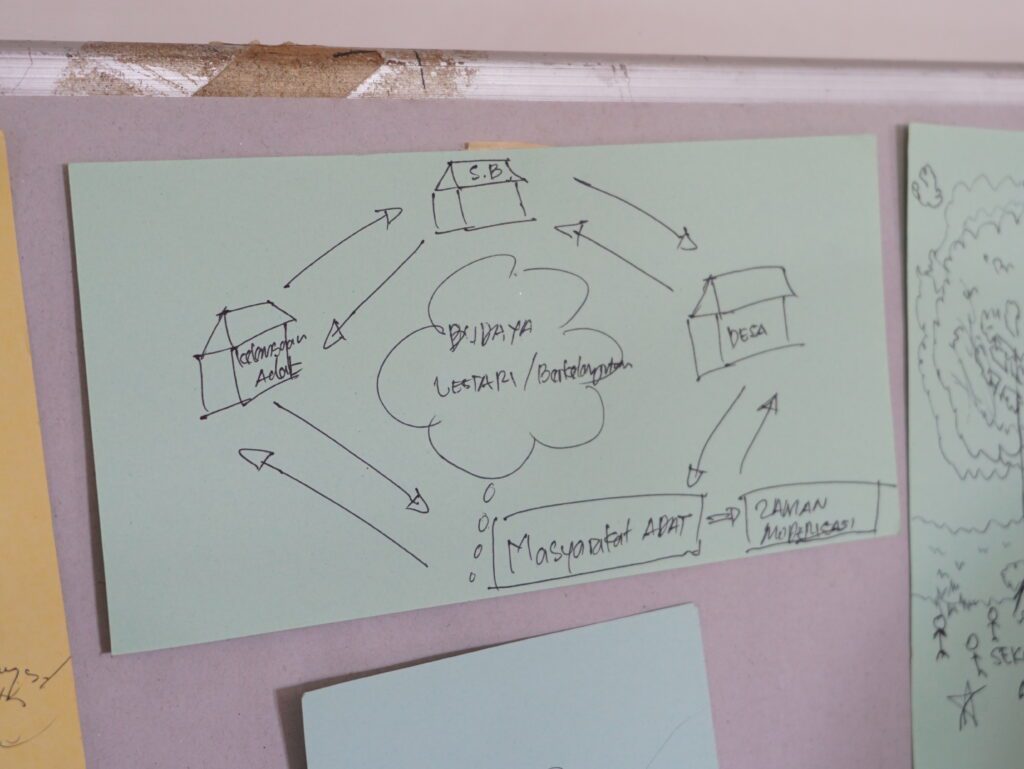
One by one, the participants then posted their drawings on flipcharts provided on the wall. The drawings depicted various forms of traditional schools.
Some depict people gathering at Datte-Datte, one of the sites where various Kaluppini rituals are performed. Others depict weaving and express their hope that the traditional school will provide weaving training. Others depict collaboration between the cultural school, the village government, the indigenous community, and traditional leaders.
Meanwhile, other participants envisioned traditional schools as spaces for learning to read and write and reintroducing traditional games.
From these images, it's clear that the traditional schools the participants envisioned weren't always classrooms with desks and blackboards. For them, learning about customs could take place in spaces where the culture itself was practiced.
However, before discussing what kind of traditional schools would be built, participants first mapped out the problems that make it increasingly difficult to learn and pass on traditional knowledge.
Challenges Faced
In the next session, participants were asked to write down the challenges currently faced by the Kaluppini indigenous community, especially regarding the younger generation's access to indigenous knowledge.
The majority of participants observed that young people's interest in learning about local customs still exists. The problem is, this interest isn't always accompanied by adequate opportunities and learning spaces.
One of the challenges is the feeling of awkwardness and embarrassment when young people want to ask the elders or people who have knowledge about Kaluppini customs.
Taufik, one of the participants, explained that many young people don't know what questions to ask when they begin learning about customs. At the same time, they worry that the questions they ask might be inappropriate. This uncertainty sometimes leads to the learning process not going as planned.
Another issue concerns the changing lives of Kaluppini's youth. Ica explained that work and education require some young people to leave their villages to pursue further education or work.
According to Taufik, this situation impacts young people's opportunities to participate in various traditional activities. Living far from their village, they can no longer participate in traditions and learn about culture as regularly as they did in Kaluppini.
Amidst these changes, some cultural practices are also starting to become rare.
Ms. Sutira explained that traditional games like bicco are being abandoned because children now access games more through gadgets. Saidi also noted that Ma'siallo, once a part of the Kaluppini community's agricultural practices, is now disappearing.
The issue that emerged in the discussion ultimately went beyond whether the younger generation still had an interest in tradition. Furthermore, participants began to see a widening gap between the younger generation and the sources of cultural knowledge that were previously present in everyday life.
Mapping Shared Knowledge
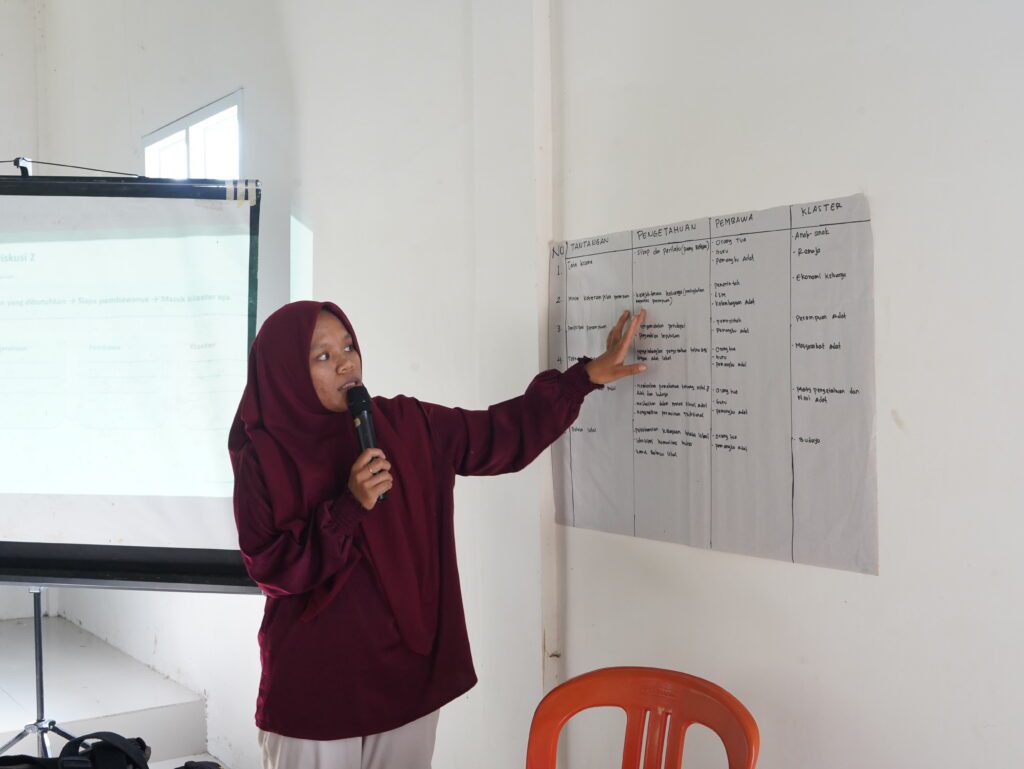
After identifying the challenges, participants were divided into three groups. Ma'ruf directed each group to map four areas: the challenges faced, the knowledge needed, the knowledge sources, and the knowledge clusters.
The discussion then led participants to more specific issues, including the position of women and the sustainability of the Kaluppini language.
Representing her group, Isra stated that Kaluppini women have actually been quite active in participating in various activities, including traditional ceremonies. However, according to her group, this participation still needs to be strengthened.
Leadership and communication skills education is considered essential for women to have stronger decision-making capacity. The group also recognizes the need to expand women's access to resources and opportunities for personal development.
At the same time, women's involvement is also related to the division of responsibilities within the family. A more equitable division of domestic and caregiving labor can provide women with greater space and time to participate in community life, including in traditional schools and decision-making forums.
Meanwhile, Ramlah raised another issue: the increasingly rare use of a number of vocabulary words in the Kaluppini language.
According to him, some vocabulary is no longer widely used in everyday conversation. An elderly person in Kaluppini also shared that some young people no longer recognize several old words, including "sondong," which means room.
For Ramlah, this situation demonstrates the importance of documenting indigenous knowledge, including language, through written archives. Documentation can be a learning resource for the younger generation and help document knowledge that is increasingly rarely used in everyday life.
However, for participants, documentation is only one part of the effort to preserve indigenous knowledge. The knowledge that has been recorded still requires space for study and practice.
From Problems to the Idea of Traditional Schools
Towards the end of the activity, the conversation slowly shifted from mapping out the problem to discussing what could be done.
Hamlet representatives invited various parties to build closer collaboration to integrate cultural values into both formal and non-formal education. During the discussion, a traditional school emerged as one idea that could serve as a learning space for the Kaluppini community.
Traditional schools are not only envisioned as places to reintroduce ancestral knowledge. They are also expected to provide spaces for the younger generation to learn through practice and direct interaction with existing sources of knowledge within the community.
Therefore, the image of the traditional school that emerged from the initial FGD is important. There's Datte-Datte as a learning space. There's weaving as a skill to be learned. There's the Kaluppini script and language that need to be documented and reintroduced. There are also traditional games that need to be revived.
All of this demonstrates that, for participants, traditional schools do not have to be separate from community life. Instead, community life can be part of the learning process.
The youth representative then reminded that such efforts require a process. It is hoped that traditional schools will not simply repeat old methods of teaching culture but will also find learning methods that meet the needs of today's younger generation.
Thus, it is hoped that traditional schools can become a meeting place between inherited knowledge and the changes currently facing the Kaluppini community.
Turning Ideas into Joint Steps
Closing the series of activities, the Head of Kaluppini Village expressed his appreciation to the participants who had participated in the discussion and to SCF who facilitated the dialogue space.
According to him, the various issues that have been mapped should not stop at the results of discussions. These findings and ideas need to be translated into actionable steps that can be taken together.
The idea of a traditional school is one of the starting points emerging from this process. Its form may not yet be fully determined. What knowledge will be prioritized, who will be the learning resources, how the younger generation will be involved, and how village governments and traditional leaders will play a role still require further discussion.
However, through this FGD, the Kaluppini community has begun to map out what they are facing and what they envision for a learning space. Ultimately, the question, "If a traditional school existed, what would it look like?" goes beyond the pictures on the wall. It opens up a broader conversation about how indigenous knowledge is learned, who has access to it, and how that knowledge can survive amidst the changing lives of the Kaluppini community.