By: M. Prayoga Aidil Fitri, Pundi Sumatra
Bepak Curiga never learned to read in school. However, as the head of neighborhood association (RT) 14, representing the Rombong Nurani Suku Anak Dalam (SAD) community in Pulau Lintang Village, he deals daily with correspondence, government administration, and various other matters that require skills he never possessed.
Every time she had to ask village officials for help with administrative matters, she was reminded of one reality: the limitations she experienced should not be passed on to her children. From that experience, a simple belief emerged that she continues to hold: "If my child goes to school, my child's fate will also change."
The changes facing the Anak Dalam Tribe community are not only related to the loss of forests as a living space, but also to changes in the way they live their lives.
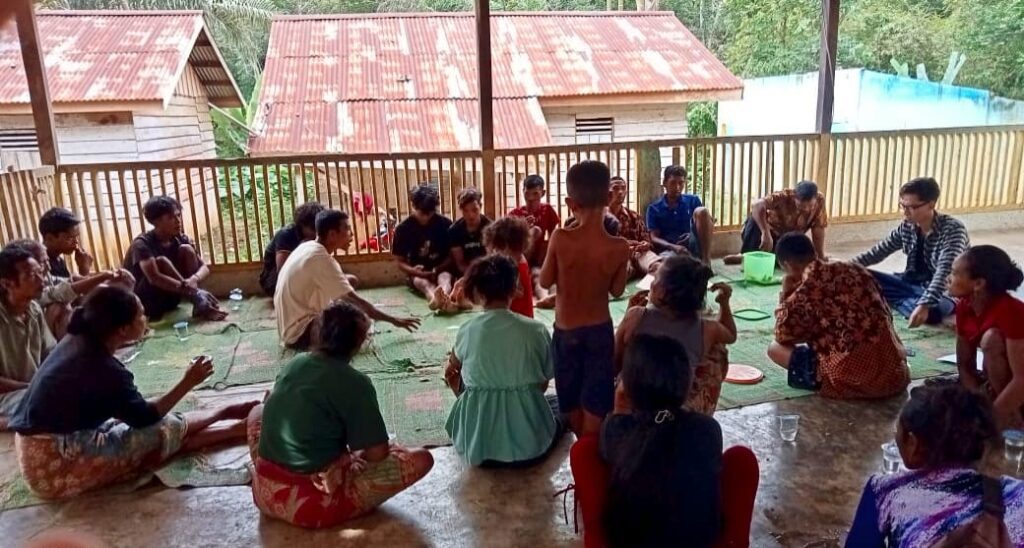
In Rombong Nurani, many families now reside in the Pulau Lintang Village settlement. They have adapted to the village administration system, formal education, and various regulations that were previously unheard of in community life. However, this adaptation has not always been accompanied by equal access to education or development opportunities.
Bepak Curiga understands these changes from a close vantage point. Besides being a parent, he is also trusted as the neighborhood association (RT) head, acting as a liaison between the SAD community and the village government. He resolves social issues within the community and facilitates communication when issues arise between the SAD residents and the village community.
Despite holding a leadership position, he realized that authority is not always enough when basic skills such as reading and writing are still limited.
As a parent who never received a formal education, Bepak Curiga learned his lessons from everyday life. He hunted, collected scraps, and gathered oil palm fruit to meet his family's needs. Through these odd jobs, he observed the lives of people outside his community. These experiences gradually changed his perspective on school. For Bepak Curiga, education wasn't merely a path to employment, but also a way to shape his thinking and decision-making.
"This school isn't just about making money. While working odd jobs and observing the lives of people out there, I realized that school makes people more mature in their decision-making."
This awareness arose not from theory, but from the comparison he saw between his own life and the opportunities others had. In Rombong Nurani, education remains unattainable for many children.
Some families prioritize short-term economic needs, forcing children to help their parents work. Others don't see school as an urgent need. At the same time, stigma against the Suku Anak Dalam community persists, often making this community viewed as backward and lacking the same capabilities as other communities. For Bepak Curiga, education offers the possibility of changing this perspective. He envisions a future where the young generation of Suku Anak Dalam are no longer just workers but also decision-makers in their own region.
"When the SAD community grows large, we must be ready. I want our children to become village heads, sub-district heads, district heads, and even regents. To get there, they must go to school."
This statement demonstrates that, for Bepak Curiga, education is a matter of representation. He wants the younger generation of the Suku Anak Dalam to have equal opportunities to lead without having to abandon their community identity.
This belief was then realized through decisions that were not always easy: continuing to send children to school even though the family's economic conditions were limited.
For their families, school is a long-term investment whose value exceeds the income the children could earn if they went directly to work to help their parents.
The journey isn't undertaken alone. The children receive support from their families, spiritual mentors, teachers, and various other individuals who continually encourage them to persevere in their education.
On the other hand, the mentoring provided by Pundi Sumatra creates a unique learning environment. Facilitators aren't simply teachers, but rather live alongside the community—discussing, sharing experiences, and assisting in their daily lives. The relationships built through trust make conversations about education more relevant to the realities faced by SAD families.
Through the Estungkara Program, young people also have the opportunity to participate in economic field schools, leadership training, GEDSI (Indonesian Empowerment and Development) strengthening programs, peer study programs, and even join the Youth Movement for Children in the Interior (GPAD). These various opportunities broaden their learning experiences while building their confidence to participate in public life.
The most noticeable changes are evident in the educational journeys of the Bepak Curiga children. Baim is continuing his higher education through a scholarship at the Al-Kitab Theological College (STTAB) in the Law Study Program. Nodi graduated from State Vocational High School 4 Sarolangun, majoring in Informatics Engineering. Meanwhile, Sarini is currently in the seventh grade at State Junior High School 18, Tanjung Village.
Each chose a different path, but all three demonstrate the same thing: when educational opportunities are available, Suku Anak Dalam children have the capacity to thrive just like children from other communities.
For Bepak Curiga, their success isn't just a matter of personal pride. He sees the change beginning to influence the perspectives of other families in Rombong Nurani. Education is slowly no longer seen as something distant from the lives of the SAD community, but as a feasible possibility.
However, Bepak Curiga realized that the changes in his family did not mean that the education problem had been resolved.
Many children with ADHD still lack educational opportunities due to economic constraints, parents' lack of understanding of the importance of education, and the stigma that still limits their opportunities. Beneath these challenges lies another layer that often goes undiscussed: gender-based workloads.
During community support, it was observed that some girls with ADHD frequently missed informal learning activities due to having to help their parents with work, care for younger siblings, or complete household chores. After carrying these burdens, participating in learning activities became difficult. In many cases, parents also preferred their daughters to help with housework rather than attend informal school.
Therefore, expanding access to education is not enough just by providing learning spaces. It also requires dialogue with families to address unequal divisions of labor, so that both girls and boys have equal opportunities to learn.
For Bepak Curiga, education has paved the way for change in his family. However, for the Suku Anak Dalam community as a whole, education only truly becomes a tool for breaking down stigma when every child—regardless of economic background or gender—has an equal opportunity to grow, learn, and determine their own future.