By: Hesti Julianawati (KKI WARSI) and Yael Stefany (PARTNERSHIP)
Not all changes can be measured by the number of electricity poles erected or the length of cables installed. There are far more significant changes. Changes that can only truly be understood by those who have lived in the dark for years.
For the women of Rombong Ngilo, the first light coming on in their homes isn't just a sign that electricity has finally arrived. It also marks the end of a chore they've had to do almost daily: fetching water.
For years, fetching water has been a chore almost exclusively done by women. After completing their morning and evening garden work, they still have to walk to the well, located about fifty meters behind the settlement. Water is drawn using a rope and then carried home for cooking, bathing, washing, and other daily family needs.
The work was repeated over and over again. Every day, every night. When it grew dark, the only light came from a small flashlight or kerosene lamp, whose light couldn't reach all the way to the well.
Along the trail, the pruned palm fronds leave behind sharp thorns. In low light conditions, the journey to fetch water is not only tiring but also carries the risk of injury due to the difficulty of seeing the path clearly. Because the activity takes place at night, women also face insecurity when having to leave the house alone in the dark.
Some families actually try to get around the situation by storing water since the afternoon. However, the reality on the ground is not always possible. Most women also work on the family farm. They collect oil palm fruit bunches, tend to food crops, or do other productive work that doesn't finish until late afternoon. When they return home, domestic chores await.
They cook. They take care of the children. They clean the house. Only after they're done do they fetch water. In many families, this work isn't shared equally. Fetching water is still seen as a woman's responsibility. This means that when the men finish working in the fields, the women continue with other chores, which continue into the evening.
This burden is often overlooked when development is viewed solely from an infrastructure perspective. Girls also experience this burden. From a young age, they begin helping their mothers fetch water, lift buckets, and complete various household chores. As a result, their time for learning becomes increasingly limited.
By the time all the work was done, it was already late at night. The light from the oil lamp wasn't bright enough for extended reading. Eyes quickly became tired. Smoke from the lamp filled the room. The next morning, they had to get up again to resume their activities. In such situations, education isn't just affected by access to school; it's also influenced by how domestic work is divided within the family.
This is where the issue of electricity intersects with the issue of gender. The lack of electricity doesn't affect everyone equally. Women bear greater consequences because they carry more of the reproductive work—fetching water, cooking, housekeeping, and caring for children. Therefore, when electricity finally arrives, the benefits to women are far greater.
The first plan once the power grid is working is not to buy a television. Not even a refrigerator. What you really want to achieve is installing a water pump. The pump will make a job that has been draining for years much easier. Water no longer has to be drawn using a rope. Women no longer need to carry buckets from the well to the house many times every day.
The time and energy previously spent on these tasks can be used for other activities, including rest. This change may seem simple to many. However, for the women of Rombong Ngilo, it means one less form of physical labor that has been passed down through generations. Electricity also brings changes to the family's productive work.
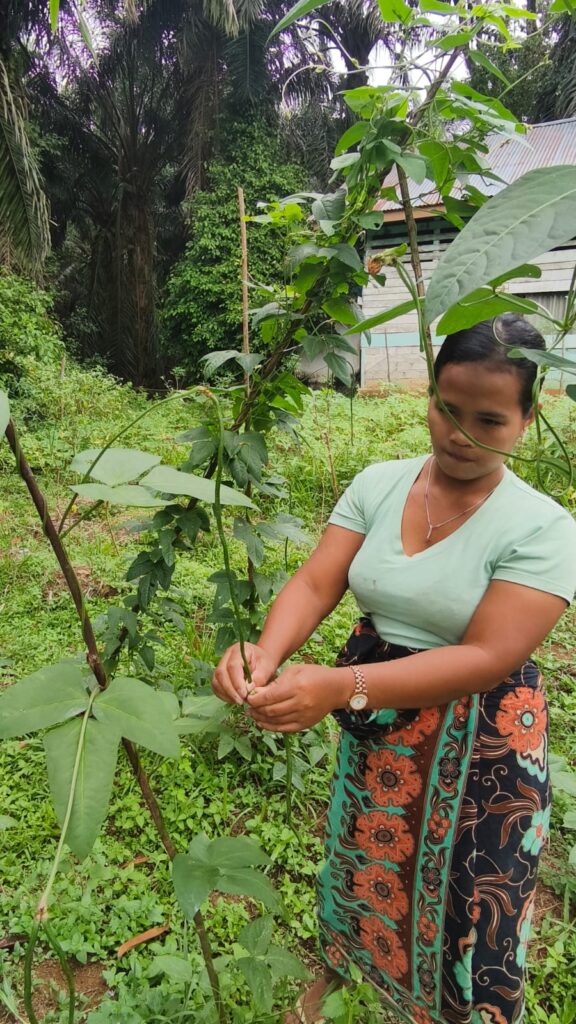
Most families now cultivate food gardens, such as kale, chilies, corn, and sweet potatoes, to meet household needs and supplement income. Caring for the plants requires regular watering and spraying. The spraying equipment they use is powered by rechargeable batteries. Before electricity, batteries had to be taken out of the village to be recharged.
Besides requiring additional costs, the process is also time-consuming. Now, the equipment can be charged directly at home. Work productivity becomes more efficient, while costs and time previously spent charging are reduced. This change demonstrates that electricity access is not only related to comfort but also impacts a family's economic security.
However, communities and their advocates recognize that change doesn't stop with the arrival of electricity. Infrastructure can reduce workloads. However, it doesn't automatically change how society divides labor between men and women. If all domestic work remains women's responsibility, this multiplied burden will persist, even after the house is lit.
This awareness is one of the reasons why the support continues after the electricity is restored. Through the Women's School currently being prepared in the community, the women of Rombong Ngilo will have a space to discuss their own life experiences—from the division of domestic labor, rights to basic services, health, children's education, to women's positions in decision-making within the family and community.
The goal isn't simply to impart knowledge. More than that, the Women's School is expected to be a space for reflection, enabling women to realize that the burdens they carry are not simply something they should accept as inherent. Some of these are the result of social roles that can be negotiated and changed collectively.
Thus, electricity became a starting point, not a finish line. It opened up opportunities to reduce women's physical labor, but the shift towards more equal relations required a longer process. A few months earlier, Ngilo Temenggung had said, in a tone of despair,
“It's no use if we always participate in activities and voice our concerns internally, because no change occurs.”
Now, when night falls on Rombong Ngilo, those words are no longer heard. Houses are beginning to light up. Children have a more comfortable space to study. Farm equipment can be charged at home. And women no longer have to end the day by walking in the dark to the well. But the story of Rombong Ngilo isn't really about the lights finally coming on.
She tells the story of how a basic right that had been unfulfilled for decades finally came into being, and how the fulfillment of that right began to open up space for a safer, healthier, and more just life for jungle women.