By: Jumi Joz, Sustainable Earth Institute
When the PARTNERSHIP team visited Kalamba Village for the INCLUSION DAY and cross-learning activities in 2024, I felt uneasy because there were no tangible results from the mentoring. I realized that our approach hadn't yielded any visible changes. This situation prompted me to re-evaluate my current approach to fieldwork.
I then remembered that a few years earlier, there had been a savings and loans group in this village called Kabubul Mamila. The group was formed by the village government, but it didn't last long due to a lack of consistent follow-up support and advocacy. The group eventually disbanded. I noted that although the group didn't survive, this experience demonstrated that the community, especially women, once had a space to organize.
I decided to meet with the former chairwoman, Mrs. Lingga Wandal. During the meeting, we discussed the reasons for the previous group's inactivity and the possibility of reactivating it. Mrs. Lingga acknowledged that the savings and loan group had helped its members, but without clear guidance, its activities had stalled. From that discussion, I proposed the idea of focusing the group not only on savings and loans but also on joint economic activities to create a more tangible turnover.
Through a personal approach and intensive communication, Mrs. Lingga agreed to help invite the women back to join. On May 5, 2025, the Kabubul Mamila Group was officially re-formed with 13 members. We started with a simple step: each member deposited Rp 50,000 as initial capital, accumulating around Rp 600,000. In addition, a monthly savings of Rp 5,000 per person was agreed upon. The capital was small, but more importantly, the commitment to starting over.
Early on in the process, I saw that the group needed an internal figure who could help mobilize its members. Anita quickly emerged as an active cadre. She helped organize monthly meetings, remind members, and manage basic bookkeeping. Anita's role was invaluable because the group wasn't entirely dependent on me as a mentor.
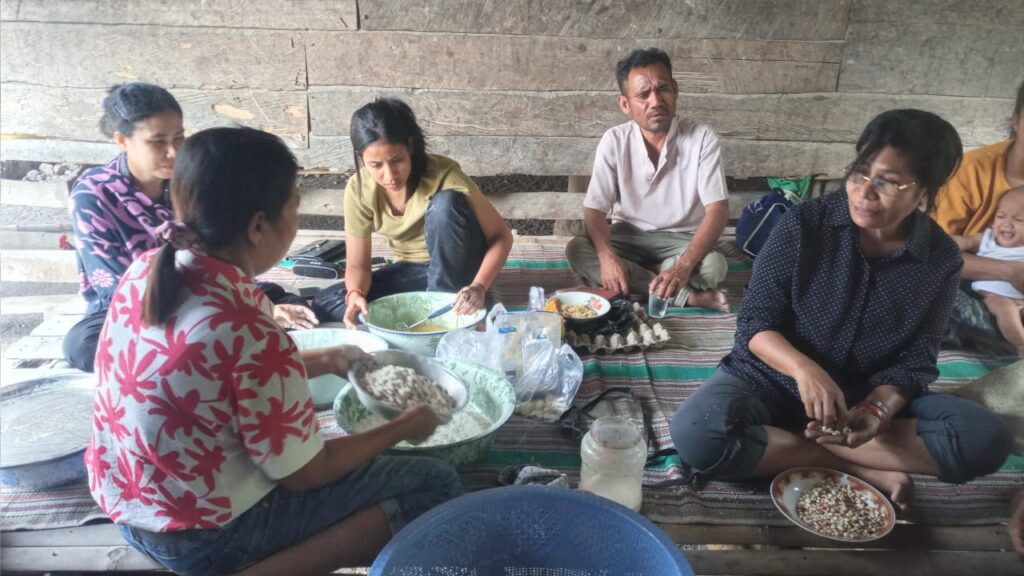
While discussing the village's economic potential, I noticed that most people grew peanuts, vegetables, sweet potatoes, and corn. This sparked the idea of processing peanuts into egg peanuts, a value-added product. I discussed this idea with Anita and then brought it to the group forum. The members agreed to try it.
We facilitated a peanut processing training with a trainer from Waingapu, Ms. Dorce. For the training, the Bumi Lestari Institute provided 10 kilograms of peanuts and other supporting materials. Five kilograms were processed into egg peanuts and five kilograms into onion peanuts. This process resulted in 94 packages of product, with total sales of Rp865,000. We used the proceeds to fund our next production. Based on our experience in the local market, we observed that egg peanuts were more in demand than onion peanuts, so the group decided to focus on egg peanuts.
By the end of the year, the group had generated a profit of around Rp1,000,000. For me, this wasn't just a nominal figure, but an indicator that the group had begun to generate business activity. They were no longer just saving and borrowing money, but also producing and selling.
However, this journey has not been without obstacles. The main challenge is the availability of raw materials. Peanuts depend on the growing season. When members' stocks run out before the next harvest, the group must purchase peanuts from villagers at a price of Rp 35,000 per kilogram. Each month, we typically purchase two kilograms of peanuts and additional ingredients like flour and oil. The total cost of purchasing ingredients can reach around Rp 250,000. This situation limits profits.
The group also doesn't have a communal peanut garden, so it relies on members' private land or external purchases. I recognize that this dependency poses a risk if the group wants to increase production. Furthermore, group discussions still focus heavily on income and capital turnover. I haven't fully facilitated discussions on the division of labor within the household or strengthening women's positions beyond the economic aspect.
Despite this, I've seen marked change. Groups that had previously disbanded are now active again with a more structured structure. Regular meetings are being held, bookkeeping is being organized, and members are involved in decision-making. Members' confidence is slowly growing as they see concrete results from their collective efforts.
For me, as a mentor, this process has taught me that change doesn't happen quickly. Revitalizing a group requires a personal approach, consistency, and patience. The challenges that emerged, particularly regarding raw materials and production capacity, serve as a reminder that mentoring must be continuously strengthened. Kabubul Mamila still has a long way to go, but the foundation for strengthening the women's economy in Kalamba Village has begun to take shape and needs to be maintained to prevent a repeat of the previous stagnation.