In a room, surrounded by dusty windows, three fans stood accompanying the footsteps of a frail and charismatic man. Swiftly, he grabbed the microphone from the MC's grasp, and stood on the podium. All participants in the Tompobulu District Office Hall were waiting for him to speak.
“…I am a Pinati, I follow what has long been in the agricultural principles of Maros and Bone, that on November 20, we all go down to plant,” said Muntu' Daeng Sila, a Pinati from Tompobulu Village, Tompobulu District, Maros Regency. His voice filled the room.
That afternoon, (10/30/2024) Daeng Sila's presence at the 2024-2025 Planting Season Tudang Sipulung (Appalili) Deliberation was odd. Because it was not according to the custom of the previous years' Tudang Sipulung Deliberation, Daeng Sila's voice was only a shout that was responded to enthusiastically by the invited guests.
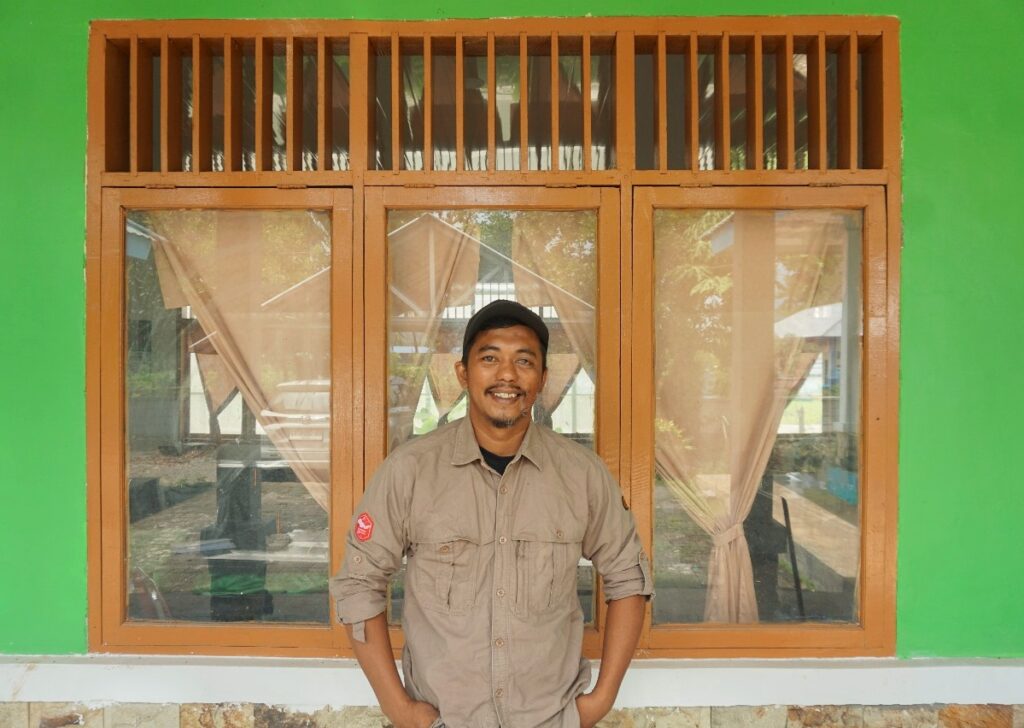
But not for Mr. Muhlis. The planting season prediction that came out verbally from Dg Sila, he wrote it down on paper. As the Head of the Agricultural Extension Agency (BPP) of Tompobulu District, Mr. Muhlis was reverent at his desk. He listened and occasionally wrote down the planting season forecast from Daeng Sila.
Apparently, Daeng Sila's involvement was an initial effort from the Tompobulu District BPP which was supported by the Tompobulu District Government. Mr. Muhlis, when discussing with him at the BPP office (11/01/2024), admitted that the decision to involve Pinati in the tudang sipulung event came from the initiative of the Tompobulu district extension workers. They agreed to include the importance of connectivity between customary knowledge and scientific knowledge in compiling planting season forecasts. Climate chaos is very real, he thought.
"Nowadays, even scientific predictions are sometimes wrong. With environmental changes becoming increasingly unpredictable, fellow extension workers feel it is important to involve Pinati like Daeng Sila, who is considered to have closeness to the Almighty and is able to read natural signs," said Mr. Muhlis.
Bringing Indigenous Knowledge to Life in Modern Agriculture
Indigenous knowledge systems are often ignored in scientific approaches because they are considered to have no measurable methodological basis. However, indigenous knowledge, especially that held by indigenous communities, contains high sustainability values. In this case, Pinati's involvement in the forecasting of planting seasons in Tompobulu District provides a new color illustration of the scientific knowledge system that is in dialogue with the indigenous knowledge system in determining the planting season.
At the Tudang Sipulung Deliberation, Daeng Sila suggested that farmers start planting on November 20, 2024. This suggestion turned out to be in line with the BMKG forecast that rainfall would be stable at the same time. This shows that local knowledge has a direct connection with the scientific approach.
Jack Kloppenburg states in his article, Social Theory and the De/Reconstruction of Agricultural Science: Local Knowledge for an Alternative Agriculture, that one of the strengths of the local knowledge system is its contextual and flexible nature. This is different from modern scientific and scientific knowledge which focuses more on an in-depth understanding of certain components through reductionist methods. The local knowledge specialization possessed by a Pinati involves a proven closeness over many years to local environmental conditions. This raises the awareness that local knowledge can provide a holistic perspective in understanding complex natural patterns.
Collaboration Between Scientific Knowledge and Indigenous Knowledge
Mr. Muhlis captured this good illustration of the tudang sipulung deliberation as a step forward for the collaboration of scientific knowledge in the world of agriculture with traditions that have lived in Tompobulu District. However, Mr. Muhlis realized that from this collaboration process, there must be challenges. In Bonto Manurung Village, the traditional agricultural ritual led by Pinati often delays the planting season.
"Sometimes they delay planting because the traditional rituals have not been carried out. This makes some farmers, increasingly less opportunity to harvest rice twice a year, because of late planting," said Mr. Muhlis.
This condition gave rise to a discourse to form a communication forum between the Agricultural Extension Agency and the Pinati community, so that the deliberation process is more coordinated. The discourse model for the formation of the Pinati forum in Tompobulu District supports the farmer-back-to-farmer model system recommended by Robert Rhoades and R Booth in the article Farmer-Back-to-Farmer: A Model for Generating Acceptable Agriculture Technology. They argue that agricultural research or predictions must be started by farmers and ended by farmers.
When scientific knowledge identifies potential solutions to solve problems, these techniques need to be tested on the farm, taking into account the experiential inputs from local indigenous knowledge systems. This collaboration then goes back to testing scientists and farmers who can work with cutting-edge technology to create better solutions. However, the main idea of this model is the continuous communication and feedback between scientific knowledge and indigenous knowledge.
In this context, the Agricultural Extension Agency in Tompobulu District has seen the importance of establishing more open communication with indigenous communities so that current technological and knowledge needs can be in accordance with local conditions.
Learning from the System Indigenous Food Security
Mr. Muhlis also explored the discourse of forming the Pinati Forum from inspiration originating from the concept of indigenous peoples' food security. As an agricultural extension worker who has interacted with indigenous villages for 12 years, he witnessed that the indigenous peoples' food security system has a depth that is difficult to reach by modern thinking.
Indigenous communities, such as the Baduy Tribe in Banten and the Kajang Tribe in South Sulawesi, have food reserves that can last for decades. The tradition of storing grain at home as a reserve is a practice that is now rarely done.
"Indigenous people used to always store grain at home as reserves for their needs for years," he said.
According to Mr. Muhlis, this is a real example of true food sustainability. Villages such as Bonto Somba Village and Bonto Manurung Village have the habit of storing grain and only selling it when it is really needed. In contrast, villages that are now sucked into modern life often sell their rice harvests immediately after harvest, without considering future reserve needs.
Food security from local knowledge systems is a step towards forming a sustainable environmental management system. Local knowledge systems have offered an alternative to stem the cycle of dependence on markets that often makes farmers vulnerable to price fluctuations and climate chaos. The local knowledge system owned by indigenous peoples in managing food, for Mr. Muhlis, is a true form of sustainability, which is not only aimed at consumption, but also to maintain food availability for future generations.
The Future of Agricultural Collaboration: Establishing the Pinati Forum in Tompobulu District
Mr. Muhlis has high hopes for the future. He aspires to form the Pinati Forum, which will serve as a forum for traditional leaders, researchers, farmers, and extension workers to have regular dialogues. This forum can be a bridge between modern agricultural technology and traditional knowledge. "Through this forum, we can learn from them, and they can also learn from the technology we offer," said Mr. Muhlis with optimism.
Lori Ann Thrupp (1989) in an article entitled Legitimizing Local Knowledge: From Displacement to Empowerment for Third World People, emphasized that equitable agricultural development must involve the direct participation of indigenous knowledge specialists (Pinati). This will encourage the creation of an agricultural system that is not only productive, but also in harmony with local culture, customs, and nature.
Through the Pinati Forum, Mr. Muhlis hopes that the agricultural technology implemented in Tompobulu District will not only benefit farmers, but also be in accordance with the customary values upheld by the indigenous community.
Mr. Muhlis realizes that the connection between scientific knowledge and indigenous knowledge is a challenging dialogue process. But he believes that these two knowledge systems can complement each other.
"For me, indigenous knowledge is something very valuable. We must maintain and preserve it, while the development of the times must also be aligned. We are not only harvesting rice, but we are also planting to preserve indigenous knowledge for future generations," he said.