FORMASI Mentawai or Mentawai Civil Society Forum is a communication forum for NGOs, media and humanitarian activists who are active in Mentawai on issues of Disaster and climate change, food security, Indigenous Peoples, gender equality and social inclusion and sanitation in Mentawai Islands Regency. The forum is one of the strategic partners for the government and other stakeholders to build a better Mentawai.
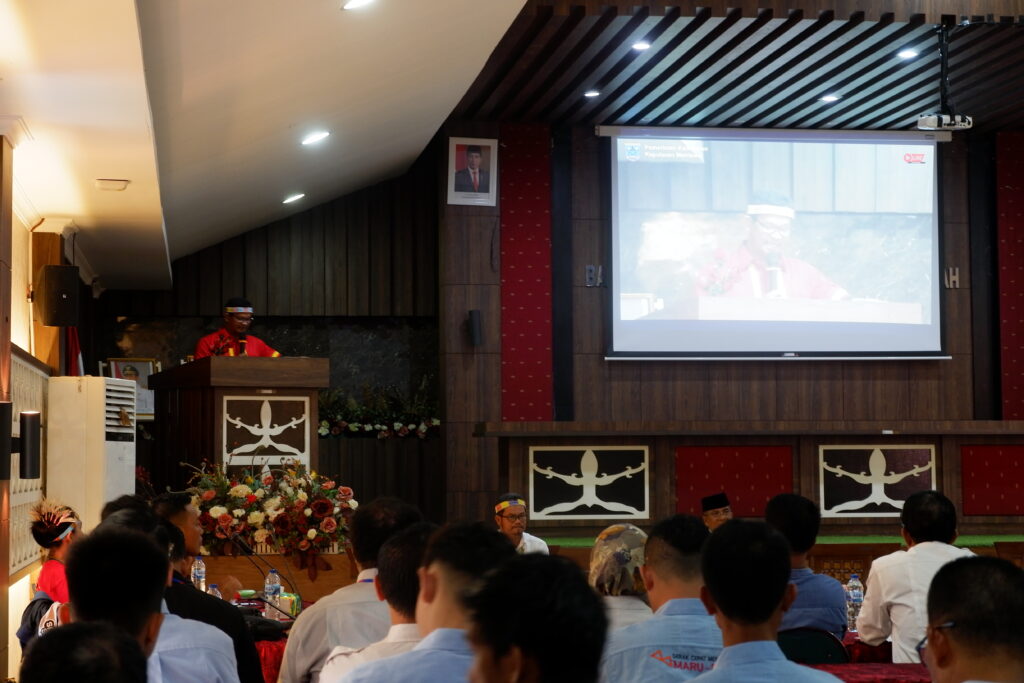
YCMM via The Estungkara Program through collaboration with KEMITRAAN and other NGOs in West Sumatra Province that are members of FORMASI, they held a Public Discussion activity with the Mentawai Regional Head Candidates with the title "Observing the Direction of Mentawai Development: An Independent and Resilient Food System in Facing Disasters and Climate Change with a GEDSI Perspective". This public discussion was held to coincide with National Farmers Day which falls on September 24, 2024 and coincides with the stages of the Pilkada which has entered the campaign period for the Mentawai Regent and Deputy Regent Candidates.
Also present were the three pairs of Candidates for Regent and Deputy Regent of Mentawai, the Chairman of the KPU, the Chairman of Bawaslu, the Regional Secretary of the Mentawai Islands, the Head of the Agriculture and Resilience Service, the Head of BPBD, the Head of Bapeda and representatives of other OPDs as well as representatives of NGO leaders who are members of FORMASI and respondents related to the issue of Food Security by Ikbal Ardiansyah from the Indonesian Sheep Foundation, the issue of Disaster and Climate Change by Fared Sirileleu from CDRM n CDS, and the issue of Gedsi (Gender Equality, Disability and Social Inclusion) by Tarida Hernawati from YCMM and Formation Coordinator by Sandang Paruhum from YCMM and moderator Indra Gunawan Sanene from YCMM.
The FORMASI Coordinator said that in the food issue, statistical data recorded the number of people aged 15 years and over working in the agriculture, plantation, hunting and fisheries sectors as many as 31,504 people or 66.45 % (Mentawai in 2024 figures). When compared to the 2018 sago production results, 1,847 tons and decreased to 690 tons in 2023. Taro in 2018 production reached 97,730 tons but in 2022 it dropped drastically to 1,041.5 tons, while rice production in 2022 was 803.29 tons and in 2023 it became 710.48 tons.
Looking at the data in 2021, rice production was only 1,005 tons while the need for rice reached 9,678 tons, if the rice imported from abroad was only 8,000 tons/year if the price of rice was IDR 12,000/kg, that means 96,000,000,000 (96M) then the choices of programs and strategies that should be carried out.
"In the future, it is necessary to increase rice production or return to local food or diversify local food such as sago, taro, banana. This must be done so that Mentawai has food independence," said Sandang Paruhum.
Meanwhile, on the issue of disasters, historical data shows that Indonesia has experienced a slow increase in temperature for years and this is also in line with the increasing trend of disasters in various regions (UNFPA, 2023). The geographical area of Mentawai which is surrounded by oceans and directly borders the Indian Ocean certainly increases the risk of disasters and the impacts of climate change which directly affect the vulnerability of the community.
BPBD Mentawai data for 2024 on disaster trends or tendencies of disaster events, especially Extreme Waves and Abrasion, Earthquakes and Tsunamis, floods and extreme weather, has increased. The threat of the Mentawai megathrust which has recently been widely discussed should be a starting point to review how far Mentawai's resilience is in facing disasters.
The implementation of governance and development of the Mentawai Islands Regency as a 3T region (Underdeveloped, Frontier, and Outermost) makes the main priority of development still focused on improving infrastructure development and other fields to catch up with other regions and get out of the 3T region.
Therefore, according to Sandang, the choice of development programs is more targeted at providing infrastructure and the economy. Because it has not used the GEDSI perspective, the choice of development programs by the local government is neutral. A view that believes that the benefits of development programs can be enjoyed by all citizens equally. In fact, in society there are marginal groups who have different abilities from citizens in general, in utilizing the results of development. This makes them lag behind the progress of government and development. These marginal groups are women, children, and disabilities. They are groups that are vulnerable to injustice and discrimination.
"Discrimination from the indigenous community environment arises from the distortion of customary law rules and prevailing cultural norms. Patriarchal culture places women as subordinates where the role and position of women are lower than men. Women become vulnerable to violence, whether physical, verbal, psychological or sexual violence in their family or social environment," he added.
Data from UPTD PPA-Social Service P3A Mentawai Regency records a high number of cases of sexual violence against women and children every year. Every year there are an average of 20 cases reported and it tends to increase every year. In fact, there are still many cases that are not reported and processed by law and are only resolved through customary and family means.
Protection and empowerment of children with disabilities are also not optimal, and until now there are no inclusive schools in Mentawai. This condition causes the vulnerability experienced by women, children and people with disabilities to increase, coupled with the emergence of.
In a separate place, pair number 1, Rijel Samaloisa and Yosep Sarogdok assessed that collaboration in the future in realizing an inclusive society is important. NGOs are strategic partners of the government as a tool of government control in ensuring gender equality, protection of women, children, and disabilities in responding to the challenges of issues that are the focus of today's dialogue, such as the issue of food security in the face of disasters and climate change.
Candidate pair number 2, Maru Saerejen and Binsar Saleleubaja, said that the activities held by FORMASI were a good thing to be able to analyze strategic issues together, such as food security issues and how to deal with crisis situations.
Meanwhile, pair number 3, Rinto Wardana and Jacop Saguruk also conveyed the need for joint collaboration to ensure that Mentawai is no longer left behind by other regions, both in ensuring the availability of local food for food security. Furthermore, to ensure readiness in facing disasters and climate change and equitable development by leaving no one behind or together equally.
This discussion is a space for exchanging ideas to see the partisanship of the government candidates in responding to issues that are still important problems in society, especially the Mentawai indigenous people who are directly affected by the issues discussed in this regional leader candidate dialogue space. This discussion is an inclusive space to ensure that marginalized groups such as the Mentawai indigenous people obtain equal rights to the results of development.